Showing posts with label Sustainability. Show all posts

Sunday, 15 June 2014

Missed Deadline - again!

Well as you can see by the web-cams, we are no where near ready to start the big dig.  So today's' deadline will come and go like many previous.

The deconstruction is now going pretty much to schedule, but we just did not start soon enough due to all the lost time re-engineering the structure to meet the new District policies. May was meant to be tear down month but both April and May were generally spent on re-engineering and drawing and getting the house fully empty.  This is one downside to doing ALL the work myself -  There is no overlap.  In general, I did not start this project prepared.  I had intended to purge and empty the house over the winter, but was generally fully occupied with drawing, redesign, and variance approvals.

I have pretty much given up on a schedule at this point and am just working as hard as I can each day to move forward. The actual deconstruction did not start until May 12 with the removal of the Kitchen followed shortly after by the laundry room.  We then had to prepare for the asbestos remediation. Since the remediation of the asbestos laden drywall completed June 4, I have been able to lift up aprox 650 sq. ft. of beech hardwood flooring (including grinding off nails), removed wood panelling from hallways,  removed all of the wood planking that was installed behind the panelling, and as of yesterday remove all of the non-bearing internal walls.

Front entrance at back left.   White wall used to be bathroom and back right was spare bedroom.  Wall in foreground is the central bearing wall holding up the ceiling joists.

Foreground was dinning room and stack of salvage 2x4.  Room behind brick chimney was laundry utilities and room to right was kitchen.  The few renaming posts are holding up some splicing in the ceiling joists near a roof valley above. Just visible behind chimney is a remaining bearing wall holding up ceiling joists at the south half of the house.
 Over the next week I hope to stack the salvaged wood outside (need to figure out where as really tight on space!), take a garbage and green waste run to the transfer station, pull up the sub-floors (this is plywood screwed to ship-lap, nailed to 2x4 sleepers. When we had the hardwood put in, I installed about 18 pounds of screws in the sub-floor to reduce the creaking that was present.  There is no way I will have the time to remove all of these screws to salvage any of the sub-flooring, so I will just be cutting it into 4ft x 4ft panels and taking to dump unfortunately), and then start taking off the exterior siding.  This should be much easier using the offset for the reciprocating saw I talked about on an earlier posting.

Lets see how well I do meeting this goal.

Thanks for stopping by!


Friday, 24 January 2014

January Update - Slowly we are proceeding.

I am getting a few questions as to where I am at on the build and so will provide this short update.

We are getting there! OK, that may have been too short.

Currently, we are waiting to hear if our development variance will be approved.  The notice went out to the neighbours between Christmas and New Years (Many Thanks to Erik at the District of North Vancouver for getting this out so quickly).  The neighbours had till Wednesday to respond with only one neighbour providing official comment (positive).  The next step is for staff to write the report to Council and for Council to deliberate on the application at the next available meeting.  This currently is scheduled for Feb 17 (I today found out it is too tight to make the Feb 3 meeting which is disappointing but totally understandable).

Back in November when I was discussing this Variance with staff, I was under the impression that they would allow me to apply for the building permit in advance of the Variance permit approval and proceed on the condition the variance is approved.  I found out this week, that I had it wrong, and that I cannot apply for the building permit until after, and if,  the variance has been accepted.  This news filled me with disappointment as I was budgeting 8-10 weeks for building permit approval based on previous conversations.  However, the kind District Plan Checker has advised they will do their best to fast track the application and could complete the process in as little as 2-4 weeks.  This would end up putting me slightly ahead of schedule.

The District staff have also confirmed I can apply for the demolition permit at any time.  This will again help, as regular readers remember, I plan to dismantle the existing dwelling by hand and reuse, sell, give away, or recycle/salvage as much of the materials as possible.  I estimated this process was going to take a month to complete.  Current plans are to move out the first few days in March, spend a couple of weeks dealing with all of 'my stuff' in the garage and attic and storage shed, and then start tackling the dismantling of items like flooring, cabinets, end the like, all stuff not controlled by a permit.  I would then schedule the services to be cut near the end of March and then start on the official 'demolition'.  These efforts would all take place in advance of the building permit and further improve my schedule.

I am also nearing completion with Tacoma, the structural engineers I hired.  This process has gone on longer than I believe both Tacoma and I expected, but we have made excellent progress and I believe are getting to the final drawing edits, having been through all the drawings at least once to date.  There has been a struggle with my desire for a thermal bridge free envelope and Tacoma's desire to ensure the dwelling stays standing for decades to come, that has been worked out with lots of 1 and 0's flying through the internet email pathways, and I am grateful for Tacoma and specifically Heather's patience through this process.  In the end, it is difficult (impossible?) to build a thermal bridge free structure utilizing 2x4 wall construction, and while complying with zoning requirements, and I have had to compromise in several areas in order to allow us to proceed with permit drawings in any reasonable time frame.  There are a few areas I will try to 'upgrade' after the permit process, but will only be able to do so if ROXUL is able to provide some compressive strength testing results for their insulation in a 6" wide configuration (what I will have as continuous insulation on the exterior of the sheathing).

As you recall I recently completed a proposed plumbing waste pipe design and am now waiting for the licensed plumber to approve or adjust as required.

I also recently commissioned EcoLighten Energy Solutions to complete a room by room heat loss calculation that I will then use to design my radiant panels.  I will speak to this a lot more in the future, but it is my feeling that the method I was taught as part of the TECA Residential Hydronic Designer course, is too crude for high performance homes.  I plan on doing a comparison between that which EcoLighten provides and that completed using the TECA method, and will post the differences here.  The preliminary model from EcoLighten shows that I will use around 50% of the energy used by a 'code built' home.  With the levels of insulation and air tightness I planned, this is actually a disappointing result, as I was hoping for something closer to a 70%+ reduction. I will go over the model in the upcoming weeks and see if there are any assumptions that can be tweaked to represent what I believe will be the final reality.

I have also commissioned HoneyComb Creative to build the project website.  HoneyComb created my home inspection website and were an obvious choice to approach for my build needs.  The website www.theEnclosure.ca should be 'live' in approximately 4-8 weeks with at least the basic functionality, and then will be fleshed out as the project proceeds.  The site will include 'live' video, time laps photographs,  a link to this blog, a daily project diary, special component installation videos, dwelling design details, sponsorship links with promotional literature for sponsored products, and finally information and basic instrument readings for the science lab (once the dwelling is complete).  I am looking forward to the site launch and have been very pleased with the initial artwork provided.

Well, I believe you are caught up.   I will be posting documents pertaining to the variance application and the permit application, including all drawings, as I get through those hurdles.

As always, thanks for reading!  Please drop me a line if you have any questions or comments.


Sunday, 29 December 2013

Popsicle Stick House!

If only it was this easy!  A student builds a wonderful design from nothing but Popsicle sticks.

Building Popsicle Mansion Time Lapse HD

The interesting part is that he took the same amount of time to build the 1/24 scale model as I am budgeting for my build - 18 months

Should I be nervous?

Sunday, 1 September 2013

The Enclosure - Updated Exterior

I thought it might be time to provide an updated design photo showing the exterior of the dwelling as it is now modelled.  I will use the through cavity window sill and head flashing to create borders around the windows (and doors).  The infill will probably be simulated stucco cementitious panels.


Saturday, 6 July 2013

Geothermal and Liquid Thorium Reactors - Two possible answers to Fossil Fuels.

Just a quick note regarding two promising alternative sources for generating clean energy.

The first was spurred on by a Knowledge Network documentary I watched this evening on Enhanced Geothermal Systems (EGS).  This is a process being develop to bring Geothermal potential to regions of the world that do not have easy access to hot rock, water reservoirs, and fracturing of the hot rock to allow harvesting of the steam (currently only accompanying about 10% of the earths surface and may be expandable to 60-80% utilizing EGS).  The process involves creating the underground water reservoir in areas that have dry hot rocks and using techniques from the natural gas industry to fracture the rock after creating a 'man made' water reservoir over a hot rock location (rock in close proximity to Magma).  The result is the same super-heated steam available in true geothermal regions.  The documentary also covers research into new drilling techniques that use flame jet instead of a drill bit to drill through solid granite up to 10X the speed of conventional drilling.

This is a National Geographic production and I was unable to find an official source for the video but did find this YouTube video in English with Portuguese subtitles.

The second potential energy source is new way to create nuclear power.  Nuclear power has created a huge divide between those that support it and those that do not.   On the one hand it can create almost limitless volumes of energy with relatively low emissions.  The catch however is the technology utilized throughout the world is very inefficient (3-5% of the energy is utilized in the fuel rods before they become waste) and this leaves behind spent fuel with a very high radio active content and in huge volumes.  The real drawback is that this waste has a half life in the several hundred of thousands of years.  The final concern, propelled to the forefront after the devastating Japan earthquake in 2011, is that current technology is very hard to stop once it gets going.  The Fukushima nuclear plant will take decades to cool down the cores of the three stricken reactors and decommission the plants (it is taking 3000 people daily to keep the reactors cool, 2 years after the explosions).

But what if another technology existed that would burn the fuel to much higher efficiency,  would created a fraction of the waste volume, the waste would have a half life in the hundreds of years instead of hundreds of thousands of years,  and the fusion process could be shut down almost instantaneously and without human intervention in case of an emergency?  Liquid Fuel Thorium Reactors (LFTR) promise just that. This reprint from the American Scientist is a great introduction to the technology and the missed opportunities that we have had.  It also outlines some of the challenges to switching technologies in the future (mostly political).

Some benifits to LFTR:
  • liquid fluoride salts are impervious to radiation damage eliminating the shutdowns needed to change out traditional fuel rods every 18 months.
  • It is much cheaper to fabricate the fuel
  • Because the liquid fuel does not break down due to thermal cycling and radiation, it can stay in service until a much higher percentage of the fuel if burned up
  • Fission poisons like Xenon (materials that absorb electrons reducing the output of the fission process) are easy to remove from liquid fuel because the bubble to the surface. Other unwanted materials are easily removed from liquid fuel by fluorination or plating techniques, greatly prolonging the viability and efficiency of the liquid fuel.
  • Wastes created byLFTR only need a few hundred years of isolated stroage vrs a few hundred thousand years for sold fuel rods.
  • The liquid salt coolant in a Salt Nuke is not under pressure (reduces the cost by not requiring a pressure containment building)
  • A Salt Nuke can be designed to auto extinguish during any calamity that causes a power failure.  Once a frozen salt plug melts, the core would dump into a sub-critical catch basin.

Wednesday, 3 July 2013

Light House completes Pilot Project on Deconstruction

Light House Sustainable Building Centre Society completes pilot project analyzing the costs and time needed to deconstruct part of a single family residence before renovation.

Their report, published here, indicates there are some savings to be realized under some conditions, but that we have a long way to go before this can be common place.

As my time is 'free', I plan to spend up to a month deconstructing my house before starting construction on my upcoming build.  The items I plan to reuse, sell, salvage, give away, and recycle include:

  • Studs and joists - Reuse/Donate/Recycle (They can be ground up and added as a soil conditioner - Clearview Grinding Ltd).
  • Plywood - Reuse/Donate
  • Ship lap - Recycle
  • Shingles - Recycle (http://www.gemacosales.com)
  • Exterior Concrete bricks - Reuse/Sell/Donate
  • Cedar Siding - plane down to remove paint to reuse and sell.  The stuff is 1.75" at the narrow end.
  • Wiring, metal piping, bathtub and sinks - Salvage (will need to strip insulation of wiring for best prices, a job that will be left till after construction).
  • Drywall - Recycle
  • Light & Plumbing Fixtures - Reuse/Donate
  • Plastic Piping and other plastic products - Recycle (www.pacificmobiledepots.com takes any plastics that cannot go into the curb side blue box)
  • Solid Wood flooring Reuse/Sell/Donate
  • Bath and Kitchen Cabinets - Reuse (Shop)/Donate
  • Stove and Dishwasher - Recycle (they are both beyond there service life and are being babied to last this last year)
  • Fridge - ReUse (we just bought it a few years ago)
  • Aluminum window frames - Salvage
  • Window blinds/Shower Door/Boiler - Donate
  • HWT - Reuse or dontate
  • Laundry appliances - Reuse for while then donate
  • Electrical Panel - Reuse as sub-panel (newer 200A panel)

Stuff that will probably go to the landfill:
  • Interior and Exterior Doors
  • Single Pane Glass
  • Painted Wood
  • Insulation (very old mineral wool and some fibreglass)
  • Counter tops (laminate)
  • Ceiling tiles (may be hazardous)
The last item is the concrete slab.  I would like to have it ground up and be able to use it as additional granular material for back-filling but at the very least I will find a place where it is needed as fill.

As you can see, my plans are ambitions and if successful, I would  divert over 90% by weight or volume away from the typical landfill process. Some of the effort like stripping the wiring or the paint of the siding will have to wait till after the build process. But with some planning and a little hard work, this should all be easily achievable, bring in some income or good karma and significally lower the carbon output of my demolition process.

Thanks for reading and as always, I encourage your comments.


Tuesday, 15 January 2013

Does Global Warming Exist? ah .... Yes!

I was recently involved in a Linked-in conversation that turned to a discussion of "Does Global Warming exist".

I was flummoxed that there were still those today, who totally deny the evidence right in front of them and, who state this is all just self serving propaganda and lies.  I was even called a "socialist fascists" which I have to admit, threw me as I certainly do not see myself in that way. 'Global weather changes', which is what I like to call it, is a pretty well accepted fact in my region and in fact across Canada.  Many of the building science seminars and courses I have attended over the last 5 years have had at least some conversation focusing on the changing planet and the unsustainability of our current practices.  There is also a general realization, in the circles I travel, that peak oil is behind us and energy is going to get a lot more expensive in the future.

I can only surmise that those who don't 'believe', have not been exposed to the facts and are ignorant of the issues and existing measured trends.

At the recent BC Building Envelope Council AGM, Keynote Speaker - Dr. Andrew J. Weaver presented the attached presentation.

  • 10 of the warmest years on record have been since 1998 (pg 18)
  • The energy provided by the Sun to the upper atmosphere has been pretty stable since 1978, but the surface temperature of the earth is rising rapidly (pg 20)
  • The arctic sea ice has been declining rapidly, but more importantly the thickness of the remaining ice is dropping which with further increase the decline the covered ocean.  (Pg 22 to 25)
  • The extremes of the Earth's Surface Temperature are increasing rapidly (Pg 33/34)

It is really hard to dispute these facts unless your POV is that everyone is going around lying (which is a sad world to live in). Sure there are some scientists who are influenced by the funding providers (on both sides of the debate), but all of them?

I have seen so many consistent concerns by the scientific community, that I choose to believe there is some substance to it, and that we need to take action now!

But there was one slide in particular that highlights the battle we have to move towards a solution on a global scale.  Slide 2 showed that during a series of public opinion poles, 80% of Canadians believed there was strong evidence that Global Warming exists, where only 58% of the USA public believed there was enough evidence to come to the same conclusions. 

As long as one of the largest resource users in the world turns a blind eye to the problems presented by climate change, are any of us going to be successful in addressing it?

Extracted from Dr. Andrew Weavers presentation to BCBEC on September 26/2012

Friday, 28 December 2012

Scotland Recycling and Vegetable Production


Well, it seems I may need to eat some crow and post some updates to my comments regarding recycling and food production in Scotland. 

I was contacted by a work colleague from a company I used to work at, who is a proud Scott and had read my entry.  He was not in agreement regarding my comments on both the lack of recycling in Scotland and the lack of fresh-locally-grown vegetables.  This interaction encouraged me to do a little research.

I have contacted each of the establishments I stayed at and have asked for the status of any recycling programs they may have.  I will post the replies as received.  In the meantime, I did some Google searching regarding recycling in Scotland and found some great info. Programs do exist, but they seem to be limited in regions served and frequency.   

A great site to start at is http://www.recycleforscotland.com/recycle.asp.  I was unable to get a match for any of the locations we stayed at (may not have picked the right regions), but it seems the program is centred around major urban regions only.  For many of the listed areas, there does seem to be great service including a ‘Blue Box’ program similar to our own.  The site claims 93% of households in Scotland have access to kerbside recycling facilities and the rest have “Recycling Centres & Points” to take your recycled products to.

Another great site was http://www.zerowastescotland.org.uk/ which seems to be more of an educational and support organization and not into the day to day activities of recycling.  It appears that through education and lobbying, this organization is creating a greater awareness and need to recycle and reduce.  It had great information on the need to recycle and how recycling impacts our planet and material stream.

I then Goggled “Recycling Centres & Points” for each of the locations we stayed at and found that some had a Centre close enough to be practical.  For instance, The Isle of Mull had a centre in the very town we stayed in: Tobermory.  Dornie had a point at their town centre.  Some spots like the one in Balquhidder, did not appear to have any reasonable options.

So I am a bit perplexed, both my wife and I are very used to recycling at home and out and about in our daily lives.  Even our ‘remote’ vacations in Tofino involve separating all recycling into provided bins and taking the ‘loot’ with us to drop off at the local centre (about 20 minutes away from Tofino near Long Beach) when we are heading back to the Mainland.  So we are very used to looking for the bins, yet in all of the places we stayed at, there was no obvious facility to separate out the recyclables from the main garbage stream.  I would imagine that the Blue Box programs are fairly successful where available, after all, how much effort is involved with throwing goods into a blue box compared to a garbage can.  But if a resident has to store up the recycling materials and bring them to a location that may be 30 minutes or more away, I can understand (unfortunately) the hesitance many would have in participating in such a program.

Does this mean that even though the facilities may be available, they are not used by a large percentage of the population?  Do only ‘urban’ residents participate?  I do not have the answers.  If you are reading this blog and live in Scotland, I would love to hear from you.

As a side note – I also checked on Chicago and confirmed it does NOT have an active recycle program.  The cost of the blue box program was turned down years ago and has to date never been re-initiated.

So, now to the topic of Scottish produce.  Again, I turned to Google.  The first site I visited (http://www.scotland.org), advised that Scotland grows 2,400 tonnes of raspberries, 4,600 tonnes of strawberries,  and over a million tonnes of potatoes per year. 900 million eggs are produced annually, 1,300 million litres of milk and there are more than two dozen cheese-makers across Scotland, ranging from the industrial cheddar creameries to much smaller-scale cheese producers (I wonder if this is a misprint as we probably have 2 dozen cheese producers in our local Gulf Islands). The site went on to state "However, beef is now the single most important sector of Scottish agriculture, worth around £400 million a year: more than fruit, dairy and poultry combined!" It also stated "The jewel in Scotland’s crown is her fish with nearly 200 shellfish farming companies. Salmon farming is the most important economic development in the Highlands and Islands over the past 30 years, and the retail sales value of Scottish salmon is around £300 million per annum. Scotland is the world’s third largest producer of Atlantic salmon and enjoys a reputation for quality fresh and added-value products such as smoked salmon."

http://www.nfus.org.uk indicated that most of the soft fruit farming is in Tayside, Angus, and similar fertile areas near Dundee (an area we did not visit but is near where my colleague grew up and forms the basis for his points of view).

I then visited http://forsythfreshproduce.co.uk/index/fresh-produce-seasonal-report and read where all the salad ingredients come from basically the UK and Holland.  Most of the vegetables were UK/France/Spain/Holland.  These results are for June which arguably is some of the best growing weather for crops like salad greens.  This information aligns with the information we were given by the ‘locals’ on our trip. “Veggies and Salad greens are not grown locally and imports are often expensive”.  Additional sites indicated limited cauliflower, broccoli, and leek production was also present in Scotland.  It was interesting to see that the Beef industry was so big in Scotland.  We saw our first cow when leaving Scotland near the Inverness airport, up until that time we only saw sheep.

http://eatscotland.visitscotland.com/food-drink/in-season/ was an excellent site to show what is potentially available fresh and local per season.
So again, I am left a bit perplexed.  If the growing conditions support fresh vegetable production and they are available in the marketplace, Why are they not served more often?   

One of the locations we stayed at (Monachyle Mhor) had its own garden, and we did have some lovely cooked greens and carrots while staying there, but our first real salad did not occur until the end of our journey at The Old Inn in Gairlock.  Our stays in Edinburgh, Tobermory, Dornie, and Nairn had considerably less choice for products that grew above the ground and left us wanting more.   

Why don’t more residents have their own mini-gardens to bolster their vegetable availability?  There certainly was the room for them in most locations we visited.  Are there difficulties I am not aware of?  Or is this just a menu preference of many of the Scottish peoples?  If so – why?  Where has the habit of game and root vegetable dominance originated?  All topics for someone else’s blog I am afraid but I would love to hear from any of you that may have some insight.

Our general experience was a starting lack of fresh vegetables being made available to us during our journey.  This is the experience that initiated the original blog entry.  The thought process then evolved into our society’s general reliance on transporting fruits and vegetables and other produce clear around the world, regardless of seasons.  This is a global phenomenon and certainly is much worse at my local supermarket than anything I encountered in the UK.   

It is I believe not a sustainable practice.  It is one I hope to curb in my personal life once I finish my upcoming build and would be able to set up a garden in our back yard.  I hope to provide a majority of our vegetable needs for at least three seasons of the year.  Will I still buy Japanese mandarins every Christmas, California cucumbers in the winter, and Mexican fruit in the early spring?  Probably, but in the mean time, I am also trying to find many more local sources of produce that is grown or raised in BC to limit the energy it takes to get food to my table.

Thursday, 20 December 2012

May I present "The Enclosure"!

Well the days are ticking down and the stress level is rising, but I finally have a finished floor plan and reasonably advanced 3D model I can share with you. These are exciting times!

I have decided to call the project "The Enclosure" (sorry, no one won the $50 prize) to reflect my focus while designing.

I will use this blog and a new website that will launch in the months to come (www.TheEnclosure.ca) to promote what I feel are good decisions that encompass the below 9 guidelines. I also hope to include hourly construction photos during the entire build, live camera feed from two angles, manufacture’s technical information on the products I choose, and most important, real life figures as to cost and performance of the built dwelling, on this new website.

I hope to work with the utilities to provide live monitoring of site used energy and will also approach groups like HPO, BCIT, and the Building Envelope Engineering sector to design laboratory experiments that will provide real feedback, from the site, on the effectiveness and durability of different wall assembly structures.

To that end, I will design a 8ft high x 8ft long ‘opening’ on the north-top-floor-exterior-wall that will allow the installation of multiple ‘plug and play’ wall assemblies with instrumentation. This will allow the recording of wood moisture, relative humidity, temperatures, and heat flux through the various assemblies over time. The results, I hope, will allow calibration of computer models and determination by building officials as to appropriate assemblies to support in code changes for decades to come.

The instrument readings, I hope, would also be made available live on my website. In this way, the dwelling could have a real contribution to the scientific community and would help my goal of creating a legacy instead of a liability.

Now, if you read some of my earlier entries, you will see that this process started for me back in 1981 when I took my first drafting course in high school. Some of the concepts represented in a design I worked on through high school are still incorporated in my modern day design. Items like a low slopped roof, vaulted ceiling above the stairs and bedrooms, 'light wells', a ‘great room’, and a shop in the basement.

Other concepts are much more recent, like optimizing the floor space to be as compact as possible, incorporating SAFERhomes standards, generally following the principles of PassiveHaus, and most importantly - putting the building enclose much higher in the priorities list (with the larger portion of the budget to match).

I believe that in order to truly build a sustainable dwelling, you must follow these basic, but powerful, principles (placed in the order I believe is the most important) when laying out your design:


1) Build what society is probably going to want in terms of functionality for the upcoming decades (no sense building a small 750 square foot bungalow with 1 bedroom, that is just big enough for you, if as soon as you no longer choose to live there, it will be torn down).
2) Build as compact a floor plan as possible - Optimize your space and make only as large as needed. This does not mean that you have to feel cramped, just decide that having that 300 ft2 'master bath’, with room for a dining table in the middle of the floor, is probably not the best use of space (ours is only 118 ft2 and includes storage).
3) Limit the volume of the envelope by limiting the number of jogs in your wall design. This will reduce your overall heat loss and material use/cost. It will also make the dwelling a lot easier and cheaper to design and build in light of the new seismic requirements in British Columbia.
4) Build out of durable products that are appropriate for their intended purpose. Do not choose a ‘green’ product that does not last or protect the structure to an adequate level just because of its perceived "greenness".
5) Within the range of products available for each build element, chose ones with as little embodied energy as possible and that use as much renewable materials as possible (my focus will be to avoid as many oil based products possible).
6) Concentrate on energy reduction over site energy creation. This automatically dictates abiding by #2 and #3 above. It also dictates concentrating on the wall, roof, and floor slab assembly’s ability to resist thermal, water, and vapour flow over HVAC ‘conditioning. And in order to achieve your enclosure performance goals, you are going to have to ensure it gets a much larger slice of the budget pie, but you will be rewarded with smaller HVAC equipment sizing needs and reduced energy bills for decades to come.
7) Build Tight and Ventilate Right! YOU should decide where the ventilation air is coming from and not just leave it to chance. This gives you the opportunity to filter the air of pollen and other contaminates, and also to pre-warm/cool the air with stale air being exhausted from the dwelling. The controlled air exchange also keeps it out of the wall and roof assemblies where it can condense and ruin your day.
8) Size any required HVAC equipment to meet your reduced thermal loss or gain needs (remember parts of the continent actually need air conditioning). Oversized HVAC equipment is prevalent in the building industry, a practice that can often result in short run cycles that limit the equipment's ability to run efficiently and rid the dwelling of harmful pollutants or humidity.
9) Do everything possible to keep your partner happy in their design wishes. Yes this is still important, just at the bottom of the list and only accommodated up to the budgets constraints. So once you have paid for good windows, lots of insulation, and durable renewable products, there may not be a lot of money left for flashy but less useful features (from a future cost savings point of view), like granite counter tops in the washrooms, $50 a square foot Italian tile, $1000 shower heads (yes they exist), $30K kitchen cabinets, and the list goes on.

I will go into some of the design decisions with a lot more detail in future posting, but wanted to give you a quick overview of the design to date and some of the outstanding decisions and design tasks.

Tasks still to complete:

• Floor Truss Design
• Roof Truss Design
• Final Thermal Resistance Layer thicknesses for walls and roof assemblies.
• Window quality and U Values
• PHPP model to predict heating needs (PassiveHaus)
• Engineering of suspended garage slab
• ‘Approval’ of enclosure assemblies by my contacts in the building envelope community
• Plumbing Plan
• Electrical Plan
• HVAC equipment sizing and design (including choosing heating method – Forced Air/Hydronic/Air Source Heat Pump)
• Home Automation and low voltage design
• Site Survey
• Final Cladding design
• Final ceiling height decisions
• Layout drawings
• Permit Document Package
• Variance Application (for floor ratio*)

* My neighbourhood has its own zoning bylaw which has a requirement that upper floors can only be up to 75% of the main floor size. I am unsure of the purpose for this requirement, but it is at odds with keeping a dwelling as compact as possible (most efficient shape is a perfect square), and also runs against the new seismic requirements.

I will be asking for a relaxation of this requirement. I have made the upper floor as small as possible, but still fit in the desired 4 bedrooms and 2 bathrooms. The main floor I have also made as small as practical/desired to fit the rooms and functionality desired. This amounted to a split between the floors that is closer to an 85% ratio. I am trusting that the Municipal building department will concede to this logic and agree that this is an archaic requirement unfitting for our goal of an increasingly energy efficient building stock.

Design and Floor Plan Illustrations

Figure 1 NE Elevation


  • You will see that the north wall is almost featureless. I am fortunate to have the right sighting to make this work as I have an equally un-featured wall on the house about 15ft to the north of me. This will also support the plug and play wall ‘lab’ modules I hope to have sponsored by the building science community.
  • You will also see that except for the cut-out around the garage, the dwelling is relatively square and uses roof lines to create interest instead of multiple wall jogs. This reduces the overall envelope volume which reduces cost and most importantly – heat loss. 
  • There is a full basement but no windows and only one north side-yard door access. The basement is dedicated to utility as you will see in the floor plans below. A future owner can create light wells and convert to a living suite if desired. This was not our focus (I have dreamed of a wood shop for decades and this was the only way I was going to get it on this property, due to zoning requirement) and a suite in the dwelling would have prevented an owner-build (dwellings with suites must use licensed contractors in my region). 
Figure 2 SE Elevation

  • Generous overhangs will protect the wall penetrations from wind driven rain and on the south side will also be designed to completely shade the windows during the summer’s mid-day heat to prevent interior solar gain.
  • The foundations rise 6” above grade to allow the foundation to breath and protect the wall's wood structures from moisture related damage , but I wanted flush pedestrian access at all doors with no thresholds (to meet the SAFERhomes objectives), and so have dropped the first floor to hang off the side of the foundation on ledger boards.
  • Notice the shallower foundation below the garage. The garage will have a suspended engineered slab to allow for useful space below, but I only needed a 8ft ceiling in this space (rest of basement will have 9ft ceiling to allow for tall projects in the wood shop).
  • I still have decisions to make on the type of cladding. I am leaning to a natural stone feature wall at front and lightly stained tongue and grooved cedar cladding for the rest of the dwelling. These wood cladded areas may be broken up by cementitious panels to provide some architecture interest (say above and below windows). 

Figure 3 NW Elevation
  • Now before you all yell at me for the notch out, it is for good reason and not just ‘designed’ this way. One of the considerations when designing this house was three 125+ ft high cedars (see figure 5) on site that constrict the location and shape of the house’s outline (they have been there a lot longer than I have and have more right to the land than I). This notch is to accommodate the one cedar at the back of the house. 
  • The width of the house was further constrained by two more cedars to the south.
  • I also wanted as shallow a house as possible to preserve as much of the backyard as possible.
  • The two lookout windows on the north wall will let in some natural light and may also allow a view of the local mountains over the neighbour’s house and nearby trees. 
  • The square indicates the approximate location for the proposed lab ‘test panels’. 
Figure 4 SW Elevation

  • The low slope roofs work well with the neighbouring dwellings with the higher roof plane on the north to match that neighbours two storey home and the lower plane on the south the allow the neighbour on that side, living in a single storey dwelling (not likely to change in the decades to come), to still have some view of the mountains. 
  • The higher ratio of window glazing on the south will make good use of the solar gains that can be expected in the fall through spring, and then will be blocked out by the overhangs during the summer when the sun is high in the sky (will provide shading photos in a future blog).
  • There is a chance that the living room, kitchen, and master bedroom will overheat in the summer based on the west glazing present. We will design for the addition of movable exterior solar shading on the west wall in case of this eventuality (because interior shading is hardly ever effective – heat is already on the wrong side of the envelope).
  • The ‘look-out’ windows on top of the roof will provide natural light year round into the north side of the upper floor and solar heat gain from fall through spring.
  • Before someone yells at me for the unsafe condition shown in the above photo, I still have to design a deck that will hang off the side of the structure, and be accessed through that French door on the second floor. Fortunately, the District has already agreed that as long as this is not supported by the ground below on posts, that it will not count towards my floor space (they typically only exempt the deck area if the structure is cantilevered out from the building which of course represents huge thermal bridging). 
Figure 5 Satellite photo of lot with both neighbour's lots also shown.

  • Top of photo is North.
  • Two storey dwelling to north and single level dwelling to south.
  • Yellow square indicates build lot and outline is rough location of planned build.
  • White circles indicate location and approx. trunk size of nearby cedars. 
  • Notice a lack of shading for most of the south exposure. I will also have all 3 cedars de-limbed up to 30 ft and spiral pruned (you should never top a tree unless you are purposely consigning it to death). This will protect the roof surfaces from wind tossed branches and will provide full southern exposure to the lower fall and winter sun, but still provide great shading to about 30% of the summer days sun (9 AM through to about 11:45AM). 

Figure 6 First Floor

Design Considerations:

  • Place as much of the ‘living’ space on the south exposure as possible to capture day-time solar gain during fall to spring months. Also allows natural lighting to dominate most daytime lighting needs. On the flip side, keep as much of the utility on the north side as possible.
  • Design room layouts to provide for the natural flow of people with as little ‘intersection’ conflicts as possible.
  • Meet the needs of a home based business.
  • Allow 12ft ceiling height in garage to accommodate a hoist.
  • Open Floor Concept (makes smaller spaces look bigger and substantially reduces materials and build time). Ensure this 'open' feeling starts at the front door.
  • Isolation of bathroom from ‘Great Room’.
  • Hide stair from living area and make the most convenient for the family entrance (also ensure it took the least amount of space possible so no incorporated landings and changes in direction).
  • Accommodate the family entrance off the garage as the ‘Main Entrance’ with the most closet storage.
  • We even have some consideration to Feng Shui best practices as to best room layout, etc.
  • Door, Hall, Stairs, and all squeeze point widths to meet SAFERhomes standard.
  • Accommodate newly required seismic bands (both exterior and interior). Bands dictate location of windows and doors (interior and exterior) 
Figure 7 - Second Floor

Design Considerations:

  • All bedrooms on this floor.
  • Ensure the number of bedrooms and bathrooms were suitable for what market in area expects. This is more than needed by my wife and I, but makes the house marketable when we no longer want to be here and reduces the likelihood that it will be torn down or significantly renovated for decades to come.
  • Ensure guest bedroom is as far away from master bedroom as possible. This also holds true for the ‘TV’ room. 
  • Ensure sufficient closet space in all rooms (including bathrooms).
  • Minimize extent of hall (another area grossly out of proportion in many 'modern' dwellings).
  • Make bathrooms big enough without wasting space. 
  • Meet personal desire for more luxurious master bedroom located at the SW corner of the floor. Placing master bedroom in this location will allow that room to most benefit from solar gain in the shoulder months.
  • Ensure walls are available for required seismic bands to line up with bands below.
  • Meet my wife’s one and only requirement of a walk in closet in the master bedroom (yes I have it easy). 
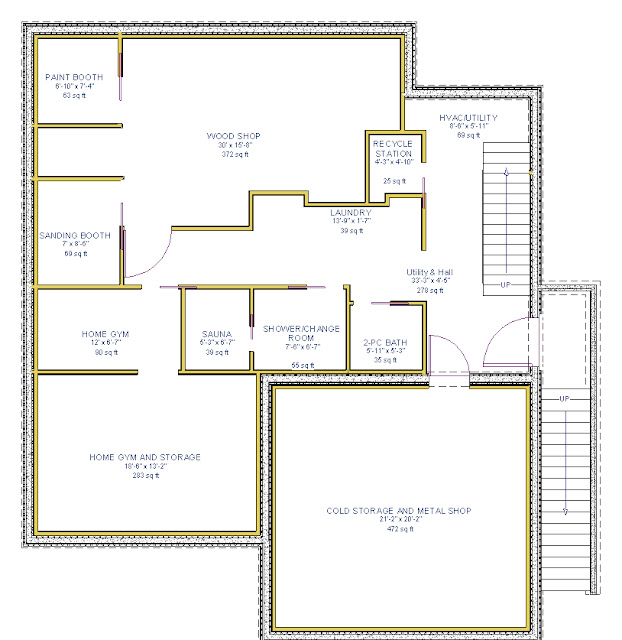
Fig 8 - Basement

Design Considerations:

  • Contain all HVAC equipment.
  • Provide Laundry facility where noise will not be disturbance to occupants. Also reduces flood hazard by not having it on upper floors (Holmes would be proud!).
  • Provide space for home gym (first hurtle, actually using it is the hardest). 
  • Fulfill life long dream of a full wood shop.
  • Provide Waste Vegetable Oil fuel processing station (upcoming blog entry).
  • Provide for computer LAN vault.
  • Provide for ample storage.
  • Accommodate a Sauna.
So there you go,  we have made great progress and may actually get this off to an on-time start.  I would welcome any feedback you may have (good or bad) and look forward to providing more information in the near future.

Open Floor Truss Supplier?

Looking for a good open floor truss manufacturer for a project in the Greater Vancouver area (British Columbia).  Any ideas?

Tuesday, 4 December 2012

Visualizing Wind Patterns

I remember multiple lectures during the BCIT BLDC 3050 & 3060 Building envelope courses that discussed the strange patterns wind can take when it hits a building.  Well some smart individual figured out a way to visual it in real time.

Check out this cool video

Wednesday, 28 November 2012

The problem with architecture is architects!

Some of you who know me, know my general bias against the architectural profession.  I have built up this bias over many years for many reasons, but primarily due to the lack of respect many of their designs show to good building science.

Well today was grounds to again support this bias and I just can't keep my thoughts contained.  Against my better judgment, I attended the Sustainabuild conference in Vancouver which is geared towards the architectural community.  My draw was one of the speakers - Murray Frank - who I highly respect and was one of the only real rays of sunshine in an otherwise cloudy and stormy day.  Fortunately he provided a presentation on good science or my head would have exploded with all of the assaults to good building science presented throughout most of the day's balance.

Let me give you some examples.  I just about bit through my tongue when one of the early presenters discussed Chicago's Aqua tower shown in the photos below and advised "we can design buildings that are able to capture solar energy".. "and get rid of excess heat within the building".  

Are you kidding me? 

The Aqua tower is an abomination to all good building science practices and pretty much eliminates the ability to separate the exterior from the interior environment due to its extreme solar bridging and moisture transport by means of the extended floor slabs.  I can advise that in the heart of the summer, you still need to have the heat turned on during cloudy days (I have the unfortunate distinction of having stayed at the hotel during a recent vacation - my wife booked the place before I realized where it was).
The Aqua Tower in Chicago - Photo by your author Summer 2012
Thermograph image showing the extreme heat bridging present in this building (Notice the 20º Celsius spread in temperatures) - Photo http://www.healthyheating.com


But the tower won some awards and was designed by a women and is pursuing the LEED certification, so it must be a good thing - right?

Wiki states "Sustainability was an important factor in Aqua's design. Gang and her team refined the terrace extensions to maximize solar shading, and other sustainable features will include rainwater collection systems and energy-efficient lighting. The green roof on top of the tower base will be the largest in Chicago." 

Why not try and make the building enclosure bullet proof before worrying about small energy contributors like lights and rainwater collection. 

Green roofs have been proven many times to not be green (they often do not reduce storm runoff, make for poor performing insulation, often need to be watered to stay alive, are often poorly installed leading to leaks, and the list goes on).  The only reason for them is a visual pleasantry and no one is going to see this one being on the top of one of the tallest buildings in the area.

The same presenter then tried to advise the room, towers are less green than low rises because they use more energy per cubic meter due to the need to "pump all that water up all those floors".  A figure of 1100 units (believe it was kWh/m2/annun) was identified for the towers and a much lower figure was used in their example for low and mid rise units.  This person was advocating that we take up more land for buildings, make the buildings shorter, and that the result would be that we needed less 'green' space and parks because there would be less shading from neighbouring buildings and I guess indicates people would be more comfortable staying in their little cubby holes. 

Fortunately there was a presenter later in the day who represented the Marine Gateway project at Marine Drive and Cambie in Vancouver.  He had actual numbers from the modelling of the development which were down around 100 units which represent a very attractive target and a well run efficient building.  But what if he was not in the room.  The first presenter's assertion that towers equated to energy inefficiency would have prevailed and could have started a whole new push by the architectural community based on poor concepts using inaccurate data.

Besides Murray's presentation, the only other ray of hope in the room for me, was the fellow who presented on the Cambie Corridor densification project and specifically the Marine Gateway project.  This project appears to be a great step towards sustainable multi-family living.  There is only 50% glazing in the residential and 51% in the commercial spaces (compared to 75%-90%+ for many downtown buildings).  The presenter went on to say that the areas that are not glazed are heavily insulated.  Finally a team with their priorities straight.  Get the building envelope right and you will have a low energy and 'green' building.

An example was made early in the day that showed the lotus car and had the presenter discussing how beautiful the cars exterior was and the true marvel was how the engineers were able to fit everything that was NEEDED into that 'beautiful' shape to make that shape FUNCTIONAL.   

I see this process as being the biggest fundamental flaw with the architectural community. 

We need to abolish this process and instead first decide on our performance goals, define our building enclosure to meet those goals using good building science, and only then allow the architects into the fray to design the perceived 'beauty' into the buildings. But only up to the point that the client can afford, after committing to the performance objectives first, and only to the point that the architects design does not impend the designed enclosure that is needed to meet the performance objectives. 

Only then will our building start to become legacies instead of liabilities and truly be 'green'!

Tuesday, 20 November 2012

Why do we continue to drill holes into our buildings?

I was recently driving by yet another building with vapour ‘diffusion’ ports (VDP’s) and it got me thinking:

Why do we continue to let our buildings be drilled full of holes?

I have always believed that the ports did not work based on previous information I had reviewed, and they are certainly not a recommendation made in the Best Practices Guide published by the Home Protection Office (HPO) in collaboration with some of the best engineering firms in the North America, firms like RDH, RJC, and Morrison Hershfield.

So why do a limited number of buildings still incorporate these ports in their designs?

First of all, we need to try and understand the intent of vapour diffusion ports. As I understand it, the intent is to help walls ‘dry out’ by allowing the wall assembly to ‘breathe’ more easily.  The ports are intended to increase the breathability of the assembly by means of diffusion, over a solid sheathing base line. By ‘breathing’, we are referring to the wall’s ability to ‘lose’ moisture in a vapour form, by allowing that moisture to go ‘through’ a wall’s materials and evaporate into the outside air (low vapour pressure side). We say walls can ‘breathe’ if all of the materials on the low vapour pressure side (which can change direction depending on conditions) are vapour-open, or that they have a high permeability.  In simple terms, this means that the pores of the material are large enough to allow a water molecule in vapour form to pass through the material.  The mechanism of passing through the assembly is usually termed ‘diffusion’, but a review of Chapter 8 of Building Science for Building Enclosures by Straube/Burnett details that the actual mechanisms involved with moisture movement through a porous material are extremely complex and can involve surface diffusion, capillary action, evaporation, convection, absorbed moisture transport, etc.  Even today, the flow of moisture through materials is not fully quantifiable by scientists or fully predictable. What is a provable fact is that in order for vapour diffusion to take place there needs to be a difference in vapour pressure across the two sides of the material (or assemblies) in question.

So are these ports working as intended?   How wide a range does each port have? Are there other mechanisms at work?  Is this an effective drying strategy?

In researching this topic I came across two related studies performed in the late 1990’s after the leaky condo crisis.  The first study titled The Envelope Drying Rates Analysis Study looked at the abilities of various wall assemblies to dry out (in lab conditions) while changing up components like sheathing materials, capillary break depth, and sheathing membrane materials.  What I found most surprising was that none of the panels were dry to safe levels (below 20%) even at the end of the 2000 hour study.

The second study titled Evaluation of Vapour Diffusion Ports on Drying of Wood-Frame Walls Under Controlled Conditions utilized the same panels, but drilled out vapour diffusion ports on some of the panels and then re-ran parts of the experiment to look at the effectiveness of the vapour diffusion ports specifically.  What was again remarkable was that, although the VDP’s did provide a minor increase in the initial drying rate of the OSB panels (no change in the rate of drying in the plywood panels which was already higher than OSB with or without the VDP’s ), all of the panels (OSB & Plywood) again contained areas with dangerous levels of wood moisture at the end of the study (which repeated the first studies results).

After reviewing these studies and Building Science for Building Enclosures,  I now have a better grasp on the true mechanisms at work with vapour ‘diffusion’ ports, and only a little of the process actually involves diffusion.  Where the ports have been effective to any measurable level, some form of convection must take place in conjunction with lots of capillary movement. Let’s look at these mechanisms in a bit more detail.

Convection (or air movement) can occur because of air leakage through an assembly from the high to low pressure side.  It can also occur by means of the convective currents that can develop within each stud bay if a low density batt and fill insulation (i.e. fibreglass) is used.  Neither of these mechanisms is desirable from an enclosure performance standpoint. Convection forces within the wall assembly can deliver moisture-rich air derived from the ‘wettest’ parts of the wall assembly (studs, plates, & insulation) and deposit that moisture onto the back side of the sheathing (which can allow a generalized increased drying rate from the sheathing by means of diffusion to the outside air). Where that moisture is close enough to a port, there can also be a localized marginal increase in permeability over the base-line sheathing.  This can help dry an assembly if no additional moisture is introduced through the convection mechanism, but air leakage through an assembly can often bring with it high levels of moisture into the assembly from the interior of the dwelling.  And once in the assembly, that moisture can then condense on any of the wall elements with surface temperatures that are below the dew point of the leaking air. (See my July/2012 and March/2012 blog entries for more info on dew points and moisture in wall assemblies).  Stud bay convective currents often create ‘air pumps’ that can lead to cold interior walls and thermal bridging, causing additional heat loss (you are bypassing the insulation by delivering heat to the outside sheathing and taking it from the inside wall board).

Now lets look at capillary and diffusion forces in connection with these ports - as areas close to the ports dry out via diffusion through the holes in the sheathing (which have a higher permeability because the moisture has to only diffuse through the sheathing membrane and not though the membrane AND the sheathing), or by air leakage through the holes (because the sheathing membrane has been damaged or is not sealed as an air control layer), that moisture is replaced by wetter neighbouring regions.  The process continues until, over time, the moisture levels within the assembly equalize.  The assembly as a whole is also trying to equalize with its lower vapour pressure neighbours (so in this geographical region, usually to the outside).  The entire process continues until all regions have the same vapour pressure (something that in practice rarely occurs as there is always changing interior and exterior humidity and temperatures which lead to changing vapour pressures).

The problem however, with relying on the diffusion and capillary forces alone is that, although capillary forces are faster than diffusion, both forces will not dry a wall assembly out fast enough to be an effective deterrent to decay and fungal growth.   This was confirmed in both studies, where portions of every test panel still had wood moisture levels in the danger zone for promoting (not just maintaining) rot, even after close to three months, regardless if VDP’s were installed or not!  These studies only had one wetting period - What happens when you have repeated introductions of moisture (interior air leakage, exterior leaks, or plumbing leaks)?

What does all of this mean? Are these results important?

Let’s look at where moisture can originate and how effective VDP’s are at addressing that moisture source.  There are five causes that come to mind:
  • Initial wood moisture elevated during construction due to the rain forest we are building in, 
  • Bulk water entry (after construction) from the exterior around poorly detailed penetrations and even through vapour diffusion ports, 
  • Bulk water entry from water pipe and drain leaks within the assembly,
  • Air leakage through the assembly causing condensation,
  • Vapour diffusion into the assembly (usually caused by excessive RH% levels in the dwelling’s interior and/or inadequate vapour control layer)

The easiest way to address the first cause is to leave the drywall, poly, and insulation off the interior of the structure until the assembly dries out.  The problem is that construction schedules are so tight; we typically do not allow adequate drying time.  If we are unable to allow sufficient time for a wall to naturally dry out before boarding, then we need accelerate the process by adding heat and air movement to the mix (and in some extreme cases, de-humidification). If we rely on the VDP’s alone to allow the wall to diffuse the moisture out and close up the assembly in a wet state, we could be waiting many months for safe moisture levels within the assembly to occur, and by that time a healthy crop of fungi would most likely have already taken root leaving us with a sick wall assembly. 
VDP’s Score: F

The second and third mechanism only has one solution – stop the bulk water entry!  There is no effective strategy to manage bulk water entry once it has occurred. Even BC’s Rain-Screen requirements will not solve repeated bulk water entry into a wall
assembly.  You must stop it at the source. 
VDP’s Score: F

The fourth mechanism of moisture entry is also somewhat simple to address. Stop the air flow through the assembly by means of an effective air control layer.  Unless you stop the air flow and the resulting condensation, the rate of moisture input will again often overwhelm the slow drying rate of a wall assembly by means of diffusion only, with or without VDP’s.
VDP’s Score: C- down to F (depending on the incoming moisture levels and type of sheathing installed). 

The final mechanism also has an easy solution in most dwellings.  Control the interior humidity by means of mechanical ventilation and/or install an effective vapour control layer in the assembly.
VDP’s Score: C down to F (depending on incoming moisture levels and type of sheathing installed).

Let’s summarize this information.  If a VDP is sealed against airflow, we are generally relying on diffusion and capillary forces and possibly stud bay convection currents to help dry out a wall assembly.   However these processes are slow, and the VDP’s only account for a limited improvement of drying potential over base lines.  As a result the assembly would typically not dry out in time to prevent decay regardless of the presence of the VDP’s.  If we allow air movement to occur through the ports, the air movement that would occur through the assembly can often bring with it levels of moisture that are easily able to overcome the limited additional drying capabilities represented by the VPD’s.

Are there downsides to including VDP’s “just in case”?

Well, it turns out these holes are usually conveniently placed just below windows and other enclosure penetrations where any incorrectly detailed flashing or membrane (like the holes drilled through all the water-resistant layers in the photo - below left) could direct water along the surface of the sheathing and into the wall assembly through these strategically placed inward water highways!  Is this really a wise practice?

We need to stop this insanity.  I put a challenge out to all of the engineering firms that know better.  Please stop allowing your buildings to be drilled full of holes. Start taking the architects, building officials, and contractors to task to stop this poor building practice. Start educating the teams you work with and let’s start building smarter!

WHAT WERE THEY THINKING?

Figure 1 Vapour ‘Diffusion’ ports (holes in sheathing that act as inward water highways) on buildings under construction in North Vancouver, BC